
A company manufactures and sells a range of products. Relevant data for one unit of a particular product are as follows.
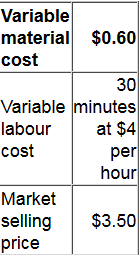
The company is using target costing to ensure that it achieves a contribution of 40% of the market selling price. In order to achieve the target cost, by how much does the company need to reduce the variable cost per unit?
GHY has two subsidiaries. GHY-Motor manufactures car engines and GHY-Build designs and assembles cars. In the car industry it is common for manufacturers to buy parts, including engines, from other manufacturers. GHY has granted GHY-Motor and GHY-Build full autonomy. GHY-Build is considering using an engine from another company for a new model that it is designing. GYY-Motor has a suitable engine, but it charges more than GHY-Build's preferred supplier. Which of the following statements is correct? Select ALL that apply.
An organization has a decentralized structure in which division A supplies division B with an intermediate product for which there is no external market. Division B carries out further processing and then sells the final product on the external market. Due to organizational policy the current transfer pricing basis is variable cost. The manager of division A has stated, 'The current transfer price is unfair because it does not enable us to recoup our costs'. The manager of division B has stated, 'The current transfer pricing system enables us to quote competitive prices for the finished product'. The Chief Executive of the organization is considering imposing a transfer pricing policy that uses dual pricing. Dual pricing would:
A manufacturing company is in the process of introducing just in time (JIT) and total quality management (TQM) into every aspect of its value chain. Which TWO of the following are appropriate changes to make to the support activities in the organization's value chain?